
SpectrumX Case Study: iHP Material Airlock Decontamination for an Annex 1 Grade B Cleanroom
SpectrumX, an MHRA-licensed “specials” manufacturer in Knutsford, Cheshire, UK, built a dedicated material airlock (MAL) that decontaminates every item with ionized Hydrogen Peroxide (iHP) before it moves from a Grade C to a Grade B cleanroom. The chamber is specified to a minimum 6-log reduction of Geobacillus stearothermophilus at worst-case locations, logs every critical cycle parameter to the batch record, and was qualified through Factory and Site Acceptance Testing and a full IQ/OQ/PQ program before first production use.
SpectrumX Project at a Glance
| Customer | SpectrumX — MHRA-licensed manufacturer of unlicensed medicines (“specials”) |
| Location | Knutsford, Cheshire, United Kingdom |
| Sector | Aseptic pharmaceutical manufacturing |
| Challenge | Moving materials from a Grade C to a Grade B cleanroom without introducing contamination, under EU GMP Annex 1 and MHRA oversight |
| Solution | One-applicator, two-door SteraMist Custom Engineered System (CES) configured as a self-contained, interlocked material airlock |
| Specification | Minimum 6-log reduction of G. stearothermophilus; H₂O₂ below 1 ppm before clean-side release |
| Qualification | FAT, SAT, and full IQ/OQ/PQ before first production use |
The Challenge: Cleanroom Material Transfer From Grade C to Grade B
Every material transfer between grades is a potential breach point. SpectrumX needed a way to bring components and materials into its aseptic Grade B environment that would hold up to MHRA inspection and support its Contamination Control Strategy (CCS) under EU GMP Annex 1. The brief called for validated GMP equipment with documented, repeatable performance.
The Solution: A Dedicated iHP Material Airlock Between Grade C and Grade B
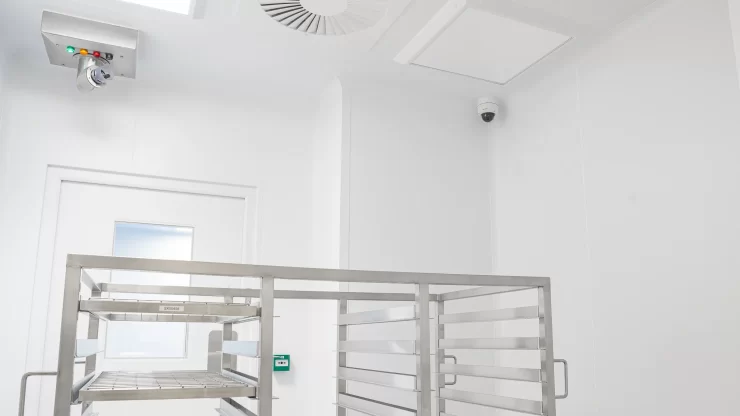
Patented SteraMist iHP technology, was engineered into a dedicated, interlocked MAL sitting directly on the boundary between the Grade C and Grade B cleanrooms.
How the installation works:
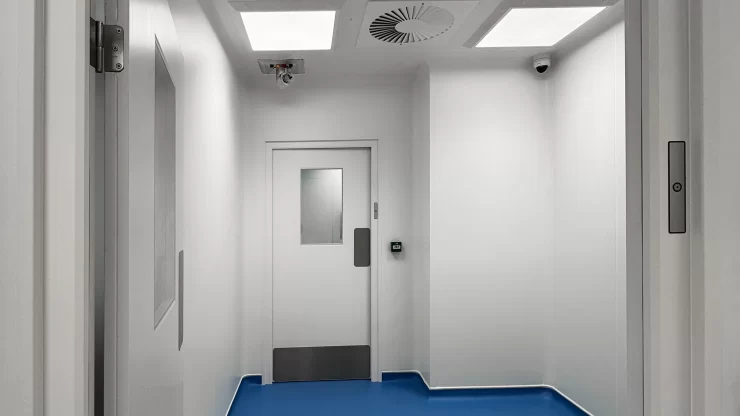
- One-applicator, into a two-door self-contained chamber measuring roughly 3.1 × 2.6 × 2.7 meters.
- One-way flow. Items load only from the Grade C side and unload only from the Grade B side, after the cycle passes every post-iHP bio-decontamination acceptance check.
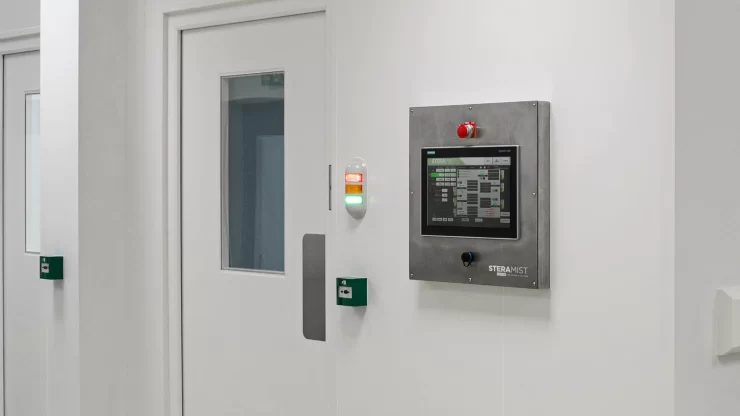
- Interlocked doors. Both doors can never open at the same time. The system defaults to a fail-safe, battery-backed locked state that releases only after the atmosphere is confirmed clear via monitored PPM and sign-off by an authorized user.
Validation Criteria: 6-Log Reduction
The MAL was specified around measurable acceptance criteria rather than general performance language:
- Efficacy: a minimum 6-log reduction of Geobacillus stearothermophilus at the hardest-to-reach, worst-case locations inside the chamber.
- Clearance: hydrogen peroxide below 1 ppm before the clean-side door releases, verified by atmospheric monitoring, so transferred items carry no detectable peroxide downstream.
- Parameter control: critical parameters such as temperature, damper position, and aeration effectiveness are logged throughout every cycle. A cycle passes only if each parameter stays within its validated range, and that record joins the batch data trail.
Why Use ionized Hydrogen Peroxide (iHP) in a Material Airlock?
Many automated systems use vaporized hydrogen peroxide, which must saturate the enclosure and hold a minimum ppm concentration throughout the cycle. SteraMist iHP works differently: converts a low concentration of hydrogen peroxide into a dry mist of submicron-sized particles containing reactive hydroxyl radicals that reach surfaces directly.
In a compact, high-frequency chamber like a MAL, that difference shows up in daily operations:
- Dry mist, not condensing vapor: a lower risk of wetting packaging and materials in transit.
- Shorter, more predictable cycles: no minimum-ppm dwell requirement to sustain.
- Material compatibility: a non-corrosive, residue-free process compatible with panelized cleanroom finishes.
GMP Data Integrity: Annex 11 and 21 CFR Part 11 Support
Because the MAL sits inside a GMP data-integrity boundary as much as a contamination-control one, the control system was built to the same standard as the efficacy specification:
- Follows GAMP 5 lifecycle principles.
- Permanently enabled, tamper-evident audit trail covering recipe and parameter changes, user access, and manual overrides.
- Supports EU GMP Annex 11 and 21 CFR Part 11 compliance.
- Role-based access: only approved, validated recipes can run.
For a site defending its Contamination Control Strategy under MHRA scrutiny, validated efficacy combined with a genuine, inspectable data trail removes one more operator-dependent variable from the transfer process.
FAT, SAT and IQ/OQ/PQ Qualification
The team engineered and integrated the iHP system into the MAL as part of the wider cleanroom build, supporting the project through:
- Factory Acceptance Testing (FAT)
- Site Acceptance Testing (SAT)
- A full IQ/OQ/PQ qualification program ahead of first production use
The result is a documented, repeatable, traceable transfer point between cleanroom grades, with contamination control engineered into the room from conception rather than added as a retrofit.
Results: A Validated, Audit-Ready Material Transfer Point
- A validated transfer point between Grade C and Grade B, specified to a minimum 6-log reduction at worst-case locations.
- Audit-ready records for every cycle, feeding directly into the batch data trail.
- No detectable peroxide downstream, with clean-side release gated on sub-1 ppm confirmation.
- Reduced operator dependency through interlocks, fail-safe door control, and recipe-locked cycles.
- A model for new builds — decontamination designed into the cleanroom rather than retrofitted.
Key Takeaways for Specifying a Cleanroom Material Airlock
- Treat the material airlock as a validated process step, not a passive room. Define efficacy, clearance, and parameter acceptance criteria up front.
- Specify against worst-case locations, using a recognized biological indicator organism such as G. stearothermophilus.
- Build data integrity into the control system from day one with audit trails, role-based access, and recipe control are what make a cycle defensible under inspection.
- Engineer decontamination into the build. Integrating the system during cleanroom design avoids the cost and validation complexity of a retrofit.
For a broader walkthrough of layout, infrastructure, and validation planning, see our guide on integrating decontamination systems in GMP cleanrooms ➔
“We’re excited to collaborate with SteraMist to further fortify our cleanroom’s microbial security. The technology makes it extremely easy to insert into any sterile workflow without compromising compliance or performance.”
Omair Sattar, Technical Director of SpectrumX
Frequently Asked Questions
What is a material airlock (MAL) in a cleanroom?
A material airlock is an enclosed chamber between two cleanroom grades that allows materials to move from a lower-grade area to a higher-grade area without opening the two spaces to each other. In the SpectrumX installation, the MAL also decontaminates items with ionized hydrogen peroxide before they enter the Grade B side.
How does SteraMist decontaminate materials in a material airlock?
SteraMist uses ionized Hydrogen Peroxide (iHP), which converts a low concentration of hydrogen peroxide into a dry, submicron mist containing reactive hydroxyl radicals. In the SpectrumX MAL, every cycle must meet its validated efficacy and parameter criteria, and hydrogen peroxide must fall below 1 ppm before the clean-side door releases.
What log reduction is the SpectrumX material airlock specified to achieve?
The chamber is specified to deliver a minimum 6-log reduction of Geobacillus stearothermophilus at the hardest-to-reach, worst-case locations inside the chamber.
How does an iHP material airlock support EU GMP Annex 1 compliance?
It provides a documented, repeatable, and traceable transfer step that fits within a facility’s Contamination Control Strategy. The SpectrumX system logs critical cycle parameters to the batch record and uses a tamper-evident audit trail supporting EU GMP Annex 11 and 21 CFR Part 11.
What is the difference between ionized and vaporized hydrogen peroxide?
Vaporized hydrogen peroxide must saturate an enclosure and hold a minimum ppm concentration throughout the cycle. Ionized hydrogen peroxide (iHP) uses a dry mist of submicron particles that reach surfaces directly, avoiding condensing vapor and removing the minimum-ppm dwell requirement.
How was the SpectrumX system qualified?
The material airlock was taken through Factory Acceptance Testing, Site Acceptance Testing, and a full IQ/OQ/PQ qualification program before its first production use.
Planning a Material Transfer or Cleanroom Project?
Whether you’re designing a new aseptic suite or rethinking material flow between grades, SteraMist can help scope a validated iHP solution for your facility.
This case study is adapted from a feature published in Cleanroom Technology, October 2026.
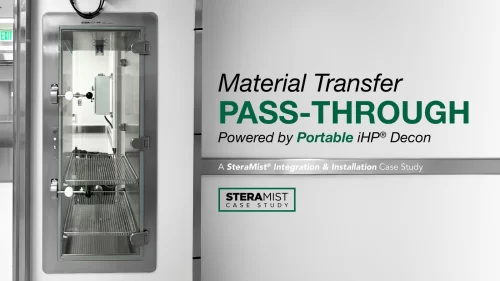
Automated iHP Passthrough Chamber Brings Fast, Flexible Sterilization to a University Bioexclusion Suite
A public research university needed a way to sterilize supplies that couldn’t go through an autoclave, from laptops and scales to pens, paper, and research equipment. Here is how a custom SteraMist iHP passthrough chamber solved it. The Challenge: Sterilizing Non-Autoclavable Supplies in a High-Containment…
Hydrogen Peroxide Disinfection Explained: Why Healthcare and Life Science Facilities Are Turning to Ionized Hydrogen Peroxide
Hydrogen Peroxide Disinfection ExplainedWhen healthcare facilities, pharmaceutical manufacturers, and research laboratories evaluate their infection prevention strategies, one technology continues to gain attention: hydrogen peroxide disinfection.But not all hydrogen peroxide technologies are…

Planetary Protection: How SteraMist iHP Decontamination Technology Safeguards the Artemis Era
While Artemis II Orbits, SteraMist Protects Earth from Martian Contaminants This week, NASA’s Artemis II mission launched four astronauts on a historic 10-day journey around the moon, humanity’s first lunar voyage since Apollo 17 in 1972. As the world watches humanity reach for deep space once more…