
Planetary Protection: How SteraMist iHP Decontamination Technology Safeguards the Artemis Era
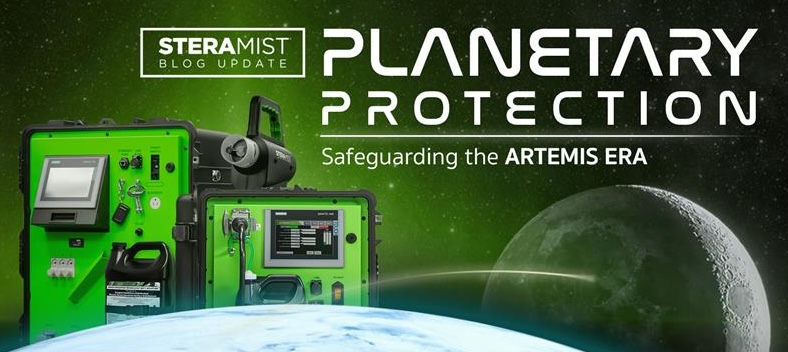
While Artemis II Orbits, SteraMist Protects Earth from Martian Contaminants
This week, NASA’s Artemis II mission launched four astronauts on a historic 10-day journey around the moon, humanity’s first lunar voyage since Apollo 17 in 1972. As the world watches humanity reach for deep space once more, a quiet but critical battle is being fought back on Earth: protecting our planet from unknown microbial threats that may return with it.
A historic week for space and biosecurity
On April 1, 2026, NASA’s Space Launch System rocket lifted off from Kennedy Space Center, sending astronauts Reid Wiseman, Victor Glover, Christina Koch, and Canadian Jeremy Hansen toward the moon in the Orion spacecraft “Integrity.” It is the boldest human spaceflight since the Apollo era and a powerful reminder of everything at stake as humanity pushes deeper into the cosmos.
But before any crewed mission can bring samples, science, or even astronauts back home, something even more fundamental must be guaranteed: that what returns from space in future missions stays contained. That is where SteraMist decontamination technology comes in.
Learn more about iHP decontamination technology ➔
SteraMist selected for planetary protection
TOMI announced that its SteraMist iHP (ionized Hydrogen Peroxide) decontamination technology had been selected for use at the Johnson Space Center in Houston, specifically in a biosafety cabinet handling samples returned from the Mars Perseverance Rover mission. The deployment, facilitated through TOMI’s distributor ARES Distribution in partnership with a U.S. government and commercial services engineering contractor, places SteraMist iHP decontamination technology at the very frontier of planetary protection science.
This is not a peripheral role. NASA’s planetary protection protocols are among the most stringent biosafety standards on Earth. The potential return of Martian material, including rock, dust, and regolith that has never been exposed to Earth’s biosphere, demands decontamination technology that leaves no margin for error.
What is SteraMist iHP decontamination technology, and why does it matter for space?
SteraMist iHP is built on TOMI’s patented Binary Ionization Technology (BIT), originally developed under a DARPA defense grant. The system converts a low concentration of 7.8% hydrogen peroxide solution into a reactive ionized plasma mist. Unlike traditional chemical disinfectants, iHP decontamination technology leaves no harmful residue and achieves sterilization at the molecular level, making it uniquely suited to the sterile, controlled environments of biosafety labs and aerospace facilities.
For handling Mars and planetary samples, this matters enormously. The biosafety cabinet sample box must be decontaminated without introducing chemical contamination that could corrupt scientific analysis of the samples themselves. SteraMist iHP’s dry fog approach, which leaves surfaces dry and residue-free, is precisely the kind of solution planetary protection scientists require.
The Artemis era demands a new biosecurity standard
As Artemis II orbits the moon and NASA charts a course toward Mars in the coming decade, the question of planetary protection is no longer theoretical. In September 2025, NASA reported that its Perseverance rover had identified what scientists described as “the closest we have ever come to discovering life on Mars” in rock samples from the Cheyava Falls site. While the scientific community continues to evaluate that finding, it underscores a reality: if life, or the building blocks of it, exists beyond Earth, the protocols for handling returned samples are not administrative box-checking. They are existential safeguards.
TOMI’s SteraMist iHP is now embedded in that safeguard system. The Johnson Space Center deployment has already demonstrated results that meet NASA’s requirements. This positions TOMI as a foundational partner in the Artemis era’s biosecurity infrastructure.
From hospitals to the cosmos
The same system trusted by hospitals, pharmaceutical manufacturers, biosafety laboratories, and food processing facilities is now being validated against the most demanding decontamination challenge humanity has ever faced.
What makes this expansion logical, not just aspirational, is that SteraMist iHP’s core attributes were always suited for precision environments: touchless application, no harmful residue, full room and cabinet coverage, and validated efficacy against bacterial spores, viruses, and fungi. Moving from an ICU isolation room to a NASA biosafety cabinet is a change of setting, not of principle. The same efficacy required for a NASA biosafety cabinet makes SteraMist the leading hospital disinfectant spray for rapid room turnover.
What this means for the aerospace and defense sectors
The validation of SteraMist iHP in a NASA planetary protection context opens a significant door. Aerospace facilities, satellite cleanrooms, spacecraft assembly buildings, and mission-critical military installations all require decontamination protocols that balance efficacy with material compatibility and speed.
As Artemis II makes history overhead and Mars’ sample return missions become a reality, the biosecurity infrastructure that protects Earth from the unknown is more important than it has ever been. SteraMist iHP is now part of that infrastructure as a validated partner in one of humanity’s most consequential scientific endeavors.
The space age is entering a new chapter. The biosecurity standard has to rise with it.
Learn more about SteraMist’s mission for biosecurity here.
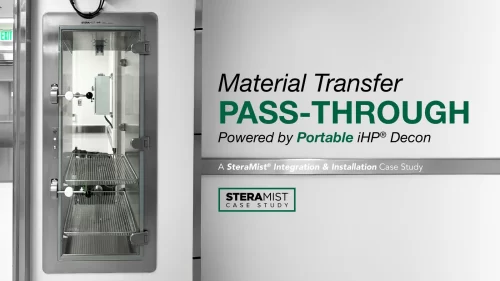
Automated iHP Passthrough Chamber Brings Fast, Flexible Sterilization to a University Bioexclusion Suite
A public research university needed a way to sterilize supplies that couldn’t go through an autoclave, from laptops and scales to pens, paper, and research equipment. Here is how a custom SteraMist iHP passthrough chamber solved it. The Challenge: Sterilizing Non-Autoclavable Supplies in a High-Containment…
Hydrogen Peroxide Disinfection Explained: Why Healthcare and Life Science Facilities Are Turning to Ionized Hydrogen Peroxide
Hydrogen Peroxide Disinfection ExplainedWhen healthcare facilities, pharmaceutical manufacturers, and research laboratories evaluate their infection prevention strategies, one technology continues to gain attention: hydrogen peroxide disinfection.But not all hydrogen peroxide technologies are…
The Power of Cold Plasma
Understanding the Need for Atmospheric Cold Plasma in Sterilization.Choosing the right decontamination method is a critical decision. SteraMist® offers a compelling solution, leveraging the innovative power of atmospheric cold plasma technology to revolutionize sterilization. But what exactly is…