
Automated iHP Passthrough Chamber Brings Fast, Flexible Sterilization to a University Bioexclusion Suite
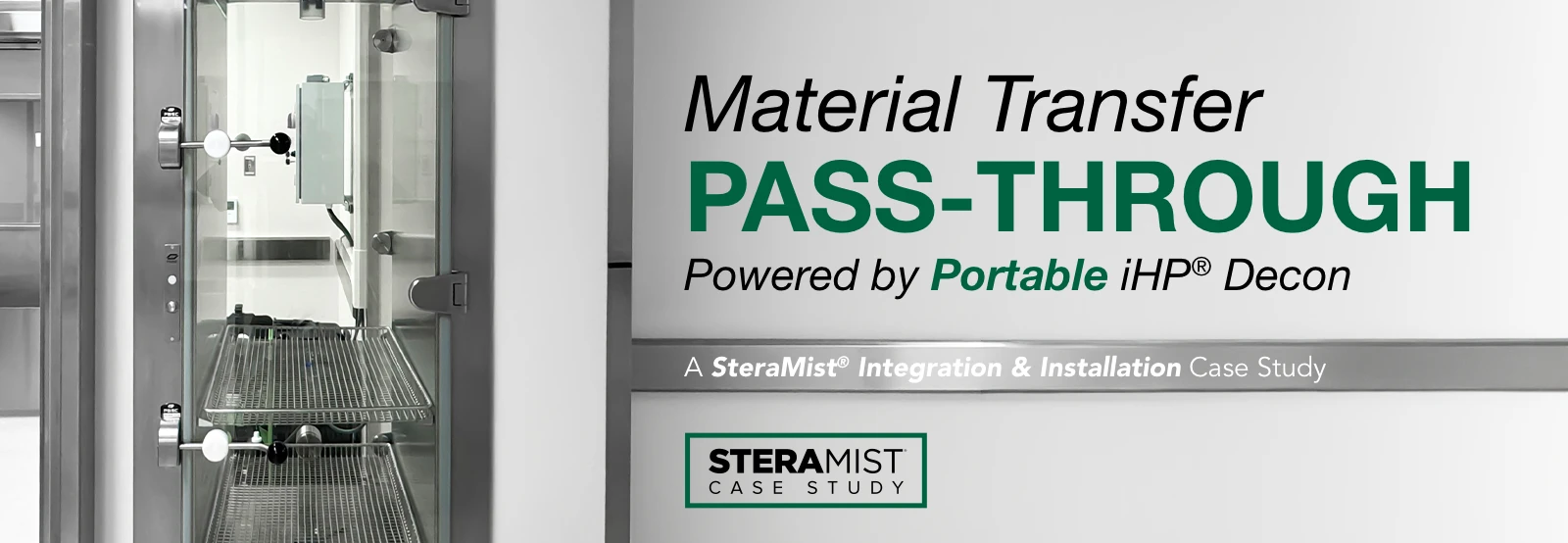
A public research university needed a way to sterilize supplies that couldn’t go through an autoclave, from laptops and scales to pens, paper, and research equipment. Here is how a custom SteraMist iHP passthrough chamber solved it.
The Challenge: Sterilizing Non-Autoclavable Supplies in a High-Containment Animal Facility
A university animal resources program was building a high-level bioexclusion suite inside one of its animal research facilities. The renovation covered extensive infrastructure work, but one problem remained: how to decontaminate everyday and electronic items, laptops, small scales, pens, paper, and research equipment, that could not be run through a standard autoclave for sterilization.
The university already owned a SteraMist Environment System, which it used to fog laboratory spaces both for routine decontamination and emergency outbreak response. That experience with ionized hydrogen peroxide (iHP) technology made the next step clear: rather than purchase a second, standalone decontamination system, the facility could get more value from its existing equipment by pairing it with a purpose-built passthrough enclosure. The portable Environment System could power the new chamber and still remain free to move wherever else it was needed in the facility. See SteraMist Life Sciences Solutions ➔
A Tight Footprint With Strict Requirements
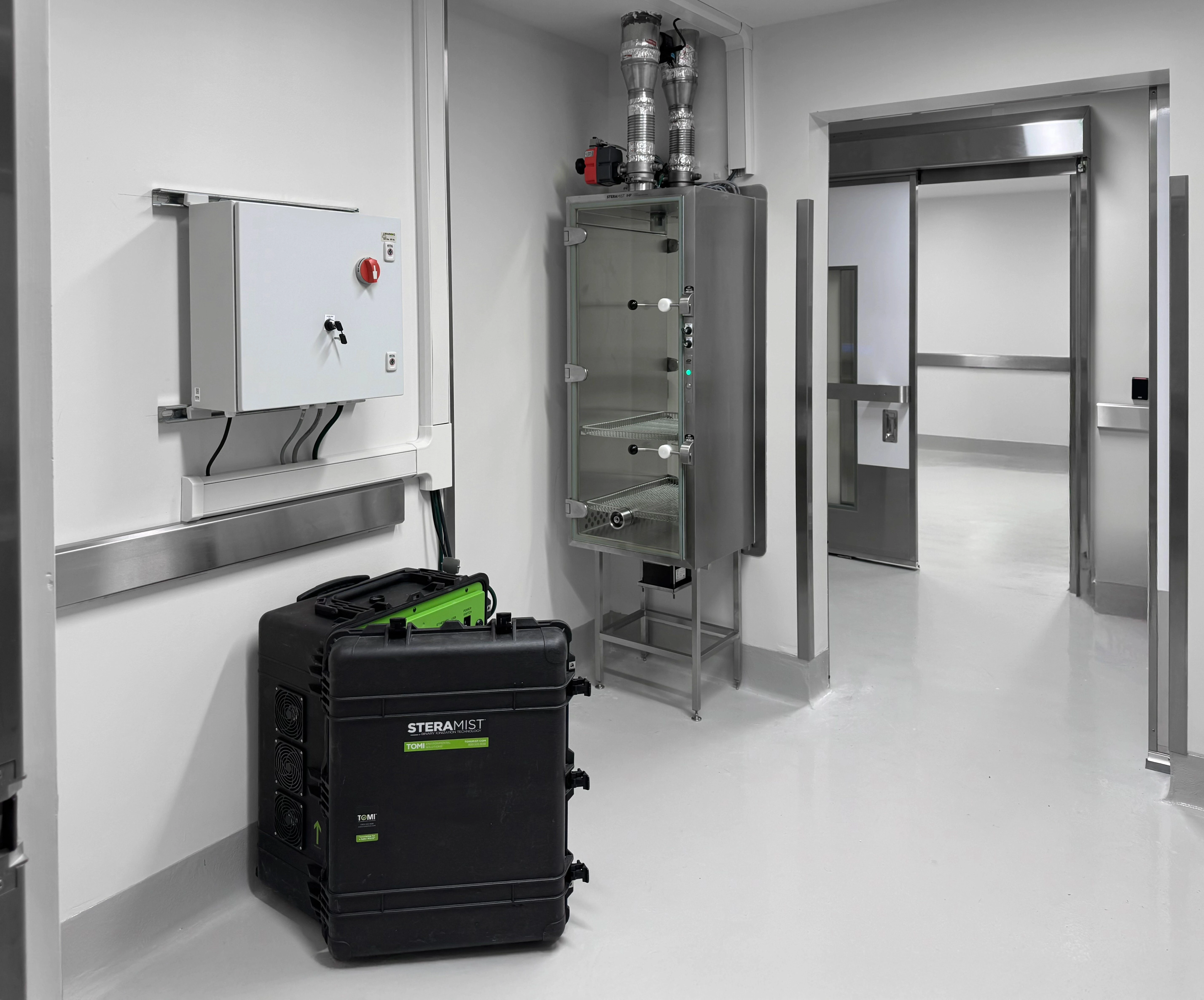
The bioexclusion suite already had an entry airlock used for donning PPE and bringing in supplies, the natural location for a passthrough chamber. But the anteroom’s limited square footage meant the enclosure had to be:
- Compact enough to fit into the adjacent wall space beside the airlock door
- Suspended and inset, rather than freestanding, to preserve usable floor space
- Fitted with mesh two-tier shelving for even air and vapor distribution across loads
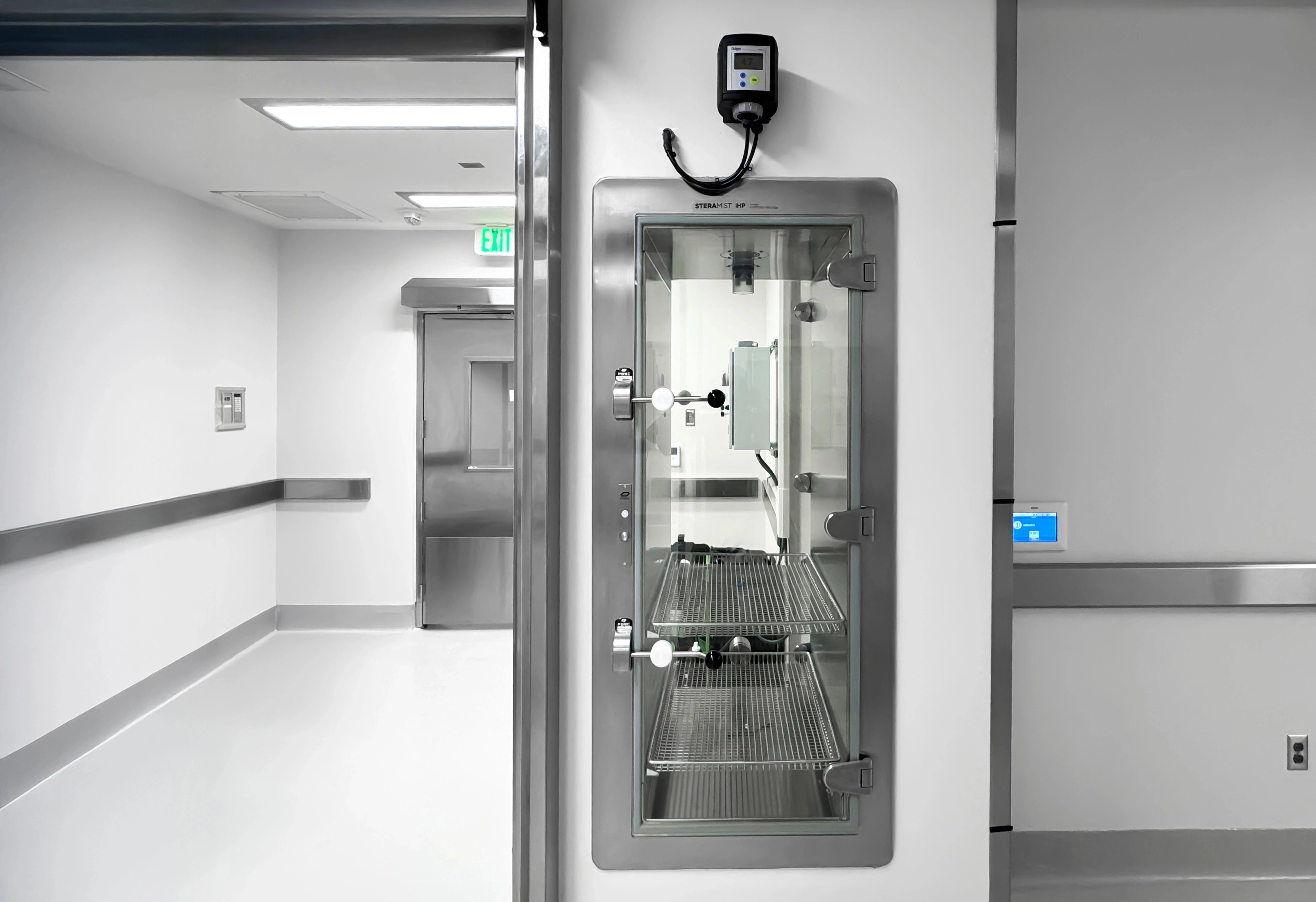
- Equipped with a monitor visible from the clean side, so staff could confirm safe hydrogen peroxide PPM levels before unlocking the chamber
Design, Engineering, and Installation
To meet these specifications, TOMI partnered with PBSC Ltd., a trusted manufacturing and design partner, to source and build the enclosure. SteraMist technicians worked directly alongside PBSC engineers to handle conditional programming and component integration, ensuring the finished system met sterility requirements and cycle demands.
The entire installation, validation, and staff training process was completed in just three weeks.
Explore the SteraMist Environment System ➔
What the Finished Enclosure Includes
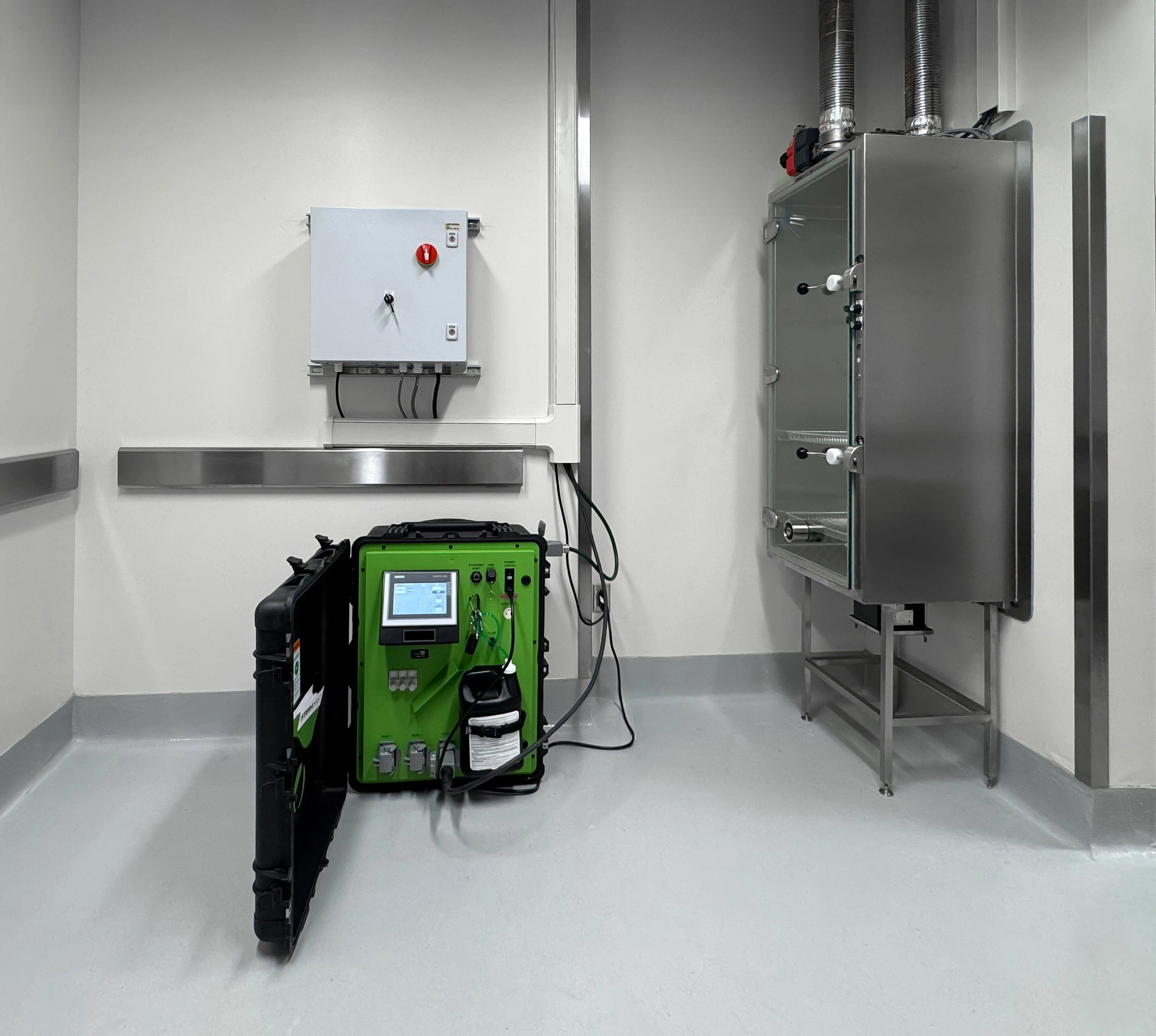
In the entrance anteroom, with controls positioned on the anteroom side for easy access. Because the system runs on a portable Environment System rather than a dedicated generator, staff simply wheel the unit into the room and connect it when needed.
The enclosure itself features:
- A cold plasma applicator nozzle mounted to the interior ceiling
- Two removable mesh shelving racks for even load distribution
- Toughened, transparent glass doors on both the clean and dirty sides
- Electro-mechanical interlocks
- Pressure relief filtration
- Fully integrated HVAC routed into existing exhaust ductwork
- Directional locking that engages automatically once a decontamination cycle is confirmed complete
Cycle Development and Qualification
After installation, SteraMist technicians developed and qualified a repeatable decontamination cycle specific to the enclosure. The validated operational sequence is:
- Press Open to unlock and open the load-side door (both door levers disengage automatically).
- Load the desired items onto the shelving racks.
- Close the door; the two levers re-engage automatically.
- Turn the key on the component box to start the cycle. A countdown begins, and the chamber’s exhaust dampeners close.
- A signal is sent to the connected SteraMist generator to begin its countdown.
- The iHP injection cycle begins three seconds after the chamber countdown starts.
- Injection takes approximately 2 minutes, regardless of load size or configuration.
- A 15-minute dwell phase immediately follows.
- During aeration, the exhaust dampeners reopen.
- Total cycle time: 90 minutes. Once the monitor reads below 1 PPM, the doors unlock.
Built-In Flexibility for a Busy Facility
When the passthrough chamber isn’t in use, staff can disconnect the Environment System and redeploy it elsewhere, including other cleanroom spaces and vivariums, while the enclosure itself remains on standby. That flexibility gives the facility contamination control it can rely on even with an irregular decontamination schedule, without tying up a dedicated generator for a single chamber.
Staff training, completed within the same three-week window, covered not only operation and maintenance of the passthrough enclosure but also broader applications of the Environment System, such as fogging rodent cage plenums.
Frequently Asked Questions
What is an iHP passthrough decontamination chamber?
An iHP passthrough chamber is an enclosed unit that uses ionized hydrogen peroxide (iHP), delivered as a cold plasma, to sterilize items that can’t be autoclaved, such as electronics, paper goods, and research equipment, as they move between a “dirty” and “clean” side of a facility.
How long does a SteraMist iHP passthrough cycle take?
In this installation, the full validated cycle runs 90 minutes total: about 2 minutes of iHP injection, a 15-minute dwell, and roughly 72 minutes of aeration before the chamber reaches a safe hydrogen peroxide level below 1 PPM.
Can a SteraMist Environment System power more than one application?
Yes. Because the Environment System is portable, it can power a fixed passthrough enclosure and then be disconnected and redeployed to fog other lab spaces, cleanrooms, or vivariums as needed, avoiding the cost of a dedicated generator for each application.
What items can be sterilized in an iHP passthrough chamber?
Items not suited to autoclave sterilization, including laptops, small electronic scales, pens, paper, and various types of research equipment, can be safely decontaminated using iHP technology.
How is safety confirmed before the chamber doors unlock?
A monitor visible from the clean side displays real-time hydrogen peroxide PPM levels. The doors remain locked via electro-mechanical interlocks until the reading drops below 1 PPM, confirming the space is safe to enter.
Learn How iHP Technology Works ➔

Hydrogen Peroxide Disinfection Explained: Why Healthcare and Life Science Facilities Are Turning to Ionized Hydrogen Peroxide
Hydrogen Peroxide Disinfection ExplainedWhen healthcare facilities, pharmaceutical manufacturers, and research laboratories evaluate their infection prevention strategies, one technology continues to gain attention: hydrogen peroxide disinfection.But not all hydrogen peroxide technologies are…

Planetary Protection: How SteraMist iHP Decontamination Technology Safeguards the Artemis Era
While Artemis II Orbits, SteraMist Protects Earth from Martian Contaminants This week, NASA’s Artemis II mission launched four astronauts on a historic 10-day journey around the moon, humanity’s first lunar voyage since Apollo 17 in 1972. As the world watches humanity reach for deep space once more…
The Power of Cold Plasma
Understanding the Need for Atmospheric Cold Plasma in Sterilization.Choosing the right decontamination method is a critical decision. SteraMist® offers a compelling solution, leveraging the innovative power of atmospheric cold plasma technology to revolutionize sterilization. But what exactly is…