
Hydrogen Peroxide Disinfection Explained: Why Healthcare and Life Science Facilities Are Turning to Ionized Hydrogen Peroxide
Hydrogen Peroxide Disinfection Explained
When healthcare facilities, pharmaceutical manufacturers, and research laboratories evaluate their infection prevention strategies, one technology continues to gain attention: hydrogen peroxide disinfection.
But not all hydrogen peroxide technologies are the same.
Today, advanced decontamination systems use ionized hydrogen peroxide (iHP) to provide rapid, effective, and repeatable decontamination for environments where contamination control is critical.
Does Hydrogen Peroxide Disinfect?
Yes. Hydrogen peroxide is an effective disinfectant that kills bacteria, viruses, fungi, and certain spores through oxidation. Ionized hydrogen peroxide (iHP) enhances this process by creating hydroxyl radicals that provide rapid, broad-spectrum decontamination with minimal residue and efficient room turnaround.
It is effective against many:
- Bacteria
- Viruses
- Fungi
- Spores
- Antibiotic-resistant organisms
Because hydrogen peroxide breaks down into oxygen and water, it leaves no persistent residue, making it attractive for sensitive environments.
How Does Hydrogen Peroxide Disinfection Work?
Traditional hydrogen peroxide disinfectants rely on direct liquid application or vapor.
Ionized Hydrogen Peroxide (iHP) takes this process a step further.
The technology converts a low concentration hydrogen peroxide solution into ionized particles containing hydroxyl radicals. These reactive species rapidly attack microorganisms and can disperse throughout enclosed spaces.
Traditional Hydrogen Peroxide Disinfection
- Liquid disinfectants
- Vaporized hydrogen peroxide
- Surface applications
How Ionized Hydrogen Peroxide (iHP) Works
- BIT Solution
- Cold plasma technology
- Hydroxyl radical generation
- Rapid decontamination
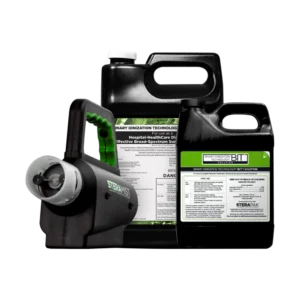
SteraMist iHP Benefits include:
✔ Broad-spectrum efficacy
✔ Rapid room decontamination
✔ Minimal residue
✔ Material compatibility
✔ Repeatable, validated cycles
What Is the Difference Between iHP and Vaporized Hydrogen Peroxide (VHP)?
This is one of the most common questions from healthcare and life science professionals.
| Feature | Ionized Hydrogen Peroxide | Vaporized Hydrogen Peroxide |
| Hydrogen peroxide concentration | Lower 7.8% H2O2 | Higher 35%+ H2O2 |
| Residue | Minimal | Minimal |
| Cycle time | Fast | Often longer |
| Material compatibility | Excellent | Can vary |
| Room turnaround | Rapid | Requires longer dwell time |
Where Is Ionized Hydrogen Peroxide Used?
Advanced hydrogen peroxide disinfection systems are commonly used in:
Hospitals
- Patient rooms
- ICUs
- Emergency departments
- Operating rooms
Pharmaceutical Facilities
- Cleanrooms
- Manufacturing suites
- Filling areas
Research Laboratories
- Animal facilities
- Biosafety areas
- Shared research spaces
Food and Agriculture
- Processing areas
- Environmental decontamination
- Research facilities
Why Facilities Are Moving Toward Automated Decontamination
Manual cleaning remains important, but facilities increasingly recognize that human factors can create inconsistencies.
Automated hydrogen peroxide disinfection offers:
- Repeatable cycles
- Consistent coverage
- Digital cycle documentation
- Reduced operator variability
- Improved biosecurity practices
For organizations focused on infection prevention and contamination control, automation helps support higher standards across operations.
Frequently Asked Questions About Hydrogen Peroxide
Is hydrogen peroxide a disinfectant?
Yes. Hydrogen peroxide is widely used as a disinfectant because it destroys microorganisms through oxidation.
Does hydrogen peroxide kill spores?
Certain hydrogen peroxide technologies have demonstrated efficacy against bacterial spores, one of the most difficult microorganisms to eliminate.
Is ionized hydrogen peroxide safe for electronics?
Many facilities choose iHP because it is designed to be compatible with a wide range of equipment and materials when used according to validated procedures.
Does hydrogen peroxide leave residue?
Hydrogen peroxide decomposes into oxygen and water, which contributes to its reputation as a clean decontamination technology.
The Future of Hydrogen Peroxide Disinfection
As healthcare, life sciences, and research environments continue to evolve, facilities are seeking technologies that provide:
- Faster decontamination cycles
- Reliable pathogen reduction
- Improved workflow efficiency
- Reduced downtime
- Scalable contamination control
Ionized hydrogen peroxide is emerging as an important solution that addresses these needs while supporting modern infection prevention strategies.
Hydrogen peroxide is a proven disinfectant used in healthcare, pharmaceutical, and research environments. Ionized hydrogen peroxide (iHP) improves traditional hydrogen peroxide disinfection by generating hydroxyl radicals that rapidly destroy microorganisms while leaving minimal residue. Facilities use iHP for room decontamination, cleanrooms, laboratories, and infection prevention programs.
Ready to Learn More?
Discover how SteraMist’s ionized hydrogen peroxide technology can help your facility improve infection prevention, contamination control, and operational efficiency.
Contact us today to speak with a decontamination expert ➔
Hydrogen peroxide is an effective disinfectant used in healthcare, pharmaceutical, and research environments. SteraMist ionized hydrogen peroxide (iHP) enhances traditional hydrogen peroxide by creating reactive hydroxyl radicals that provide rapid, broad-spectrum decontamination with minimal residue and efficient room turnaround, making it a preferred technology for modern facilities.
Related searches:
- hydrogen peroxide disinfection
- hydrogen peroxide as disinfectant
- ionized hydrogen peroxide
- hydrogen peroxide vapor sterilization
- hydrogen peroxide decontamination
- does hydrogen peroxide disinfect
- hospital disinfection technology
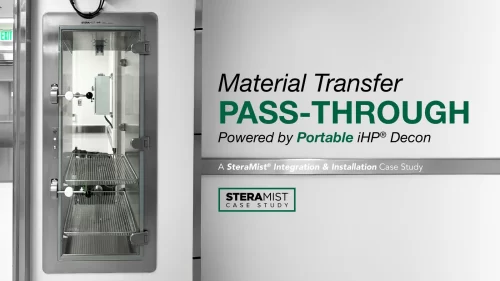
Automated iHP Passthrough Chamber Brings Fast, Flexible Sterilization to a University Bioexclusion Suite
A public research university needed a way to sterilize supplies that couldn’t go through an autoclave, from laptops and scales to pens, paper, and research equipment. Here is how a custom SteraMist iHP passthrough chamber solved it. The Challenge: Sterilizing Non-Autoclavable Supplies in a High-Containment…

Planetary Protection: How SteraMist iHP Decontamination Technology Safeguards the Artemis Era
While Artemis II Orbits, SteraMist Protects Earth from Martian Contaminants This week, NASA’s Artemis II mission launched four astronauts on a historic 10-day journey around the moon, humanity’s first lunar voyage since Apollo 17 in 1972. As the world watches humanity reach for deep space once more…
The Power of Cold Plasma
Understanding the Need for Atmospheric Cold Plasma in Sterilization.Choosing the right decontamination method is a critical decision. SteraMist® offers a compelling solution, leveraging the innovative power of atmospheric cold plasma technology to revolutionize sterilization. But what exactly is…