
Integrate Decontamination in Cleanrooms
Integrating decontamination systems into a GMP cleanroom means matching the technology to three things at once: your room’s physical layout, your existing electrical and HVAC infrastructure, and your validated compliance requirements. Done correctly, a facility gets repeatable, documented microbial reduction without adding downtime or compromising sensitive equipment. Done poorly, it becomes a recurring source of deviations.
For facilities leaders managing sterile manufacturing, cell and gene therapy suites, or multi-suite CDMO operations, that difference is not academic; it shows up in batch release timelines, audit findings, and the real cost of room turnover. Walk through how to evaluate, plan, and integrate automated decontamination systems for cleanrooms of any layout complexity.
What Are Decontamination Systems for Cleanrooms
Decontamination systems for cleanrooms are automated technologies that deliver a validated, measurable reduction of bacteria, viruses, and spores across a room, enclosure, or piece of equipment as a distinct, documented step from manual cleaning. In GMP-regulated environments, this typically means achieving and recording a 6-log reduction, supported by cycle data suitable for audit and batch-release review.
The term is sometimes used interchangeably with cleanroom sterilization, though the two are not identical: sterilization implies the elimination of all viable organisms and is typically reserved for items processed by autoclave or dedicated sterilization equipment, while cleanroom decontamination systems are validated to a specific, documented log reduction across a room, enclosure, or surface.
These systems generally fall into a few categories:
- Vaporized hydrogen peroxide (VH2O2) systems generate a gaseous H2O2 concentration that requires a minimum PPM to be maintained, along with room pre-conditioning and aeration time before re-entry.
- Ionized hydrogen peroxide (iHP) systems convert a low concentration of hydrogen peroxide into a dry, submicron mist of reactive hydroxyl radicals, reaching surfaces through superior coverage rather than sustained gas concentration.
- UV-C and fogging devices line-of-sight or wet-chemical approaches that are generally harder to validate for complex, shadowed geometries.
- Manual wipe-down protocols still required for gross soil removal, but not a substitute for a validated disinfection step under current guidance.
Why GMP Cleanroom Decontamination Requires More Than Manual Cleaning
Regulatory guidance has moved decisively toward treating cleaning and disinfection as two separate, independently validated procedures, not one combined “clean-down.” Under the current EU GMP Annex 1 framework, facilities are expected to operate under a documented Contamination Control Strategy (CCS) that accounts for this distinction directly.
Two sections are worth knowing by number if you are building or defending a CCS:
Section 4.36 calls for prior cleaning to remove surface contamination before disinfection, with ongoing monitoring of program effectiveness.
Section 5.4 requires that cleaning be validated to remove residues that could otherwise interfere with disinfectant efficacy, minimizing contamination risk at the source.
This regulatory direction, echoed in FDA guidance, EMA expectations, and standards such as EN 13697 and USP <1072>, is precisely why automated, GMP-compliant decontamination systems have become a facility infrastructure decision rather than a janitorial one. A system that cannot produce IQ/OQ/PQ documentation, audit-ready cycle data, and consistent 6-log validated performance will not hold up under a CCS review, regardless of how well it appears to work day-to-day.
Types of Automated Decontamination Technologies
Most GMP facilities choose between two dominant approaches to automated decontamination: vaporized hydrogen peroxide (VH2O2) and ionized hydrogen peroxide (iHP).
| Consideration | VH2O2 Systems | iHP (Ionized Hydrogen Peroxide) |
|---|---|---|
| Delivery mechanism | Gaseous H2O2 held at a minimum PPM | Dry, submicron mist of hydroxyl radicals via cold plasma and H2O2 combination |
| Room preparation | Often requires pre-conditioning | No room pre-conditioning required |
| Cycle time | Typically longer dwell and aeration | Documented 15-minute dwell time |
| Residue / corrosion risk | Possible on sensitive materials over repeated cycles | Residue-free, non-corrosive process |
| Material compatibility | Case-by-case with electronics and aseptic equipment | Designed for compatibility with sensitive electronics and aseptic surfaces |
| Validated efficacy | 6-log bioburden reduction (product-dependent) | Repeatable 6-log reduction against bacteria, viruses, and spores |
Both approaches can be validated for GMP use. The right choice for a given facility depends less on efficacy alone and more on how each technology fits the room’s actual layout, the equipment it needs to protect, and the throughput the operation can afford to lose during each cycle.
Key Considerations Before Integration
Before selecting or installing a decontamination system, walk through the following evaluation points. Each one changes the answer to “which configuration fits this facility?”
Map every space the system needs to reach: open cleanrooms, adjoining suites, biosafety cabinets, isolators, airlocks, and equipment interiors like lyophilizers. A single-room footprint has very different requirements than a multi-suite layout where several rooms need decontamination on a shared schedule without cross-contaminating the corridor between them.
Automated decontamination equipment draws power, generates cycle data, and in fixed configurations, requires wall or ceiling mounting. Confirm the following before integration:
- Dedicated electrical circuits to avoid voltage drops affecting sensitive instrumentation nearby
- Panel and control-hub placement in grey space or technical corridors, preserving cleanroom access for maintenance
- Stable pressure cascades and HEPA filtration that won’t be disrupted by the decontamination cycle
- Accessible test ports to support IQ/OQ validation without compromising room integrity
Confirm the system can generate what your quality team will actually need: EPA registration where applicable, GMP/ISO-compliant validation and qualification documentation, audit trails suitable for 21 CFR Part 11, and cycle data that supports your facility’s Contamination Control Strategy.
Every decontamination cycle takes a room offline. Shorter, validated dwell times protect production schedules; systems that require extended aeration before re-entry compound downtime across a facility running multiple rooms per week.
Cleanrooms increasingly house sensitive electronics, single-use assemblies, and delicate aseptic equipment. A decontamination technology that corrodes or leaves residue on repeated exposure becomes a long-term asset-protection problem, not just a disinfection question.
Solving Complex Cleanroom Layouts: Portable, Fixed, and Hybrid Configurations
Complex cleanroom layouts are where decontamination integration most often breaks down not because the underlying technology fails, but because a single-room solution gets stretched across a multi-room facility it was never configured for.
Three configurations address most layouts:
- Portable systems treat one room at a time, with independently controlled applicators and cover large or irregular room shapes. This suits facilities with a smaller number of rooms or infrequent cycles.
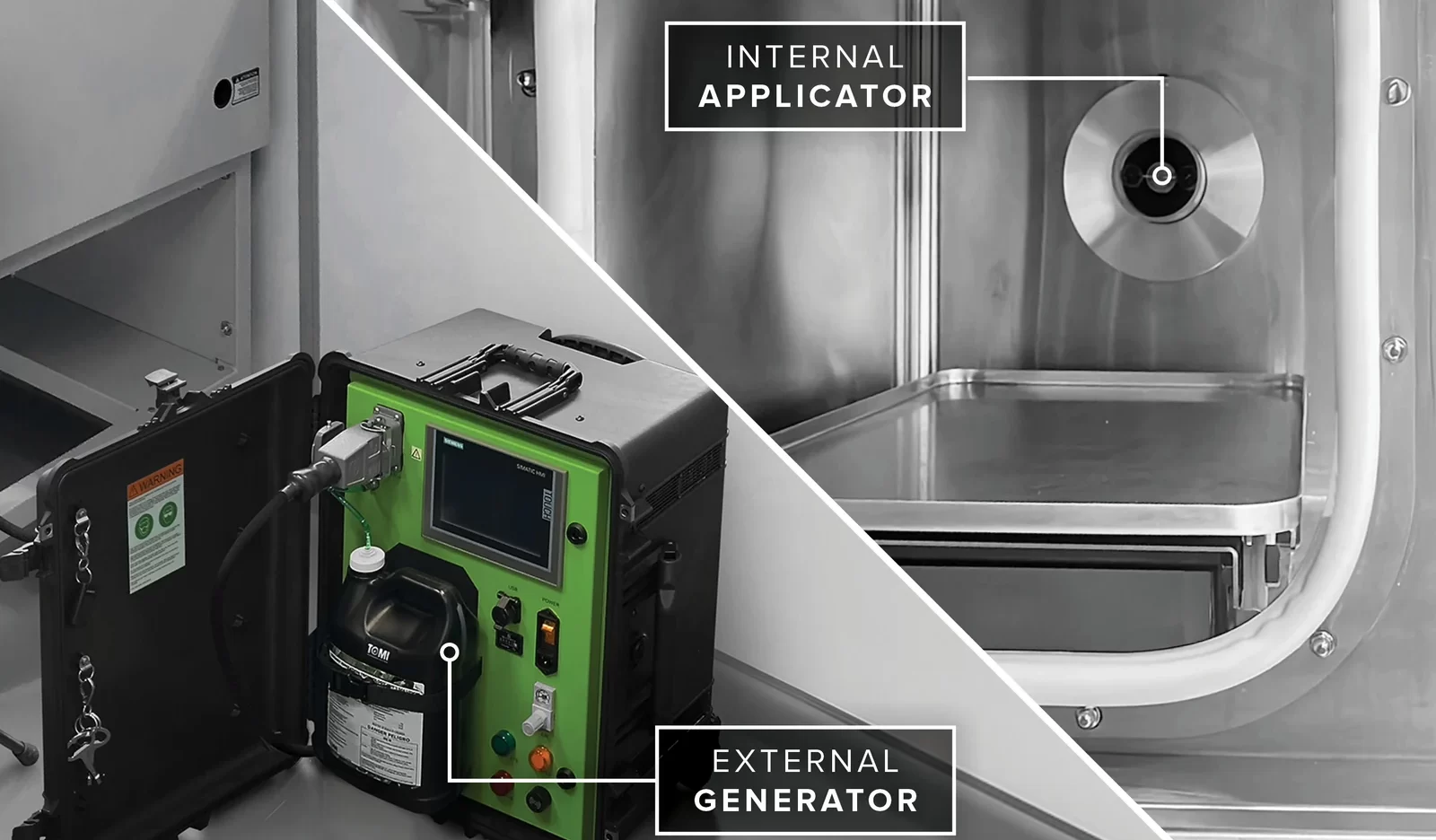
- Fixed, mounted systems serve a single high-frequency room, such as an isolator or BSC enclosure, with automated daily cycles that reduce manual labor and improve consistency.
- Hybrid configurations connect a portable unit to ceiling-mounted applicators in adjacent rooms through a shared control hub, enabling decontamination across multiple connected spaces without moving equipment room to room. This is generally the most efficient path for CDMOs and multi-suite manufacturers managing several rooms on a shared cycle.
Matching the configuration to the layout rather than forcing one hardware footprint across every room is what keeps integration projects on schedule and validation straightforward.
Common Integration Mistakes to Avoid
- Treating decontamination as an afterthought in room design. Retrofitting electrical and mounting infrastructure after construction costs more and risks compromising finished cleanroom surfaces.
- Validating against manufacturer data alone. Room geometry, equipment load, and airflow all affect real-world performance; site-specific IQ/OQ/PQ is not optional.
- Underestimating multi-room complexity. A configuration that works well in a single suite can create bottlenecks when scaled across a facility without a hybrid or networked approach.
- Ignoring material compatibility over time. A technology that appears compatible in a short trial can still cause cumulative wear on sensitive equipment across hundreds of cycles.
- Skipping the service plan. Without scheduled maintenance and support, even a well-integrated system drifts from its validated baseline.
A Step-by-Step Framework for Integrating Decontamination Systems
-
Audit the space. Document every room, enclosure, and piece of equipment that needs coverage, including adjacent or interconnected suites.
-
Define the compliance target. Establish the validated log-reduction standard your CCS requires and the documentation your quality and regulatory teams need from every cycle.
-
Match configuration to layout. Decide between a portable unit for single-room flexibility, a fixed wall- or ceiling-mounted system for high-frequency single rooms, or a hybrid configuration for multi-room coverage from one control point.
-
Confirm infrastructure readiness. Verify electrical capacity, control-hub placement, HVAC stability, and test-port accessibility with facilities engineering before installation.
-
Run IQ/OQ/PQ validation. Qualify the installed system against your specific room geometry and equipment load, not just the manufacturer’s baseline data.
-
Build the operating protocol. Document cycle initiation, applicator placement, monitoring, and data retention as part of standard operating procedures.
-
Establish a service and support cadence. Scheduled maintenance and technical support keep validated performance consistent between requalification cycles.
Building Decontamination Into Your Facility, Not Around It
Integrating a decontamination system into a GMP cleanroom is ultimately an infrastructure and compliance decision as much as a technology choice. Facilities that map their layout complexity, confirm infrastructure fit, and validate against their own room geometry, rather than a manufacturer’s baseline, end up with a system that supports throughput instead of working against it.
SteraMist’s iHP-based Environment System, Hybrid configuration, and Integrated System are built for exactly this range of scenarios, from single-room treatment to networked multi-suite decontamination, backed by validation, qualification, and scheduled service support. If your facility is evaluating decontamination integration for a new build or an existing complex layout, that assessment is the right place to start.
Frequently Asked Questions
Cleaning removes visible soil and residue from surfaces, while decontamination is a separate, validated step that achieves a documented microbial log reduction. Current GMP guidance, including EU GMP Annex 1, requires both as distinct, independently validated procedures within a facility’s Contamination Control Strategy.
Cycle times vary by technology. Vaporized hydrogen peroxide systems often require room pre-conditioning and extended aeration, while ionized hydrogen peroxide (iHP) systems can achieve a validated 6-log reduction with a 15-minute dwell time and no pre-conditioning step.
Yes. Hybrid and Custom configurations connect a central control hub to ceiling-mounted applicators across several adjacent rooms, allowing multi-suite facilities to run decontamination cycles without relocating equipment between rooms.
It depends on the technology. Residue-free, non-corrosive processes are designed for compatibility with sensitive electronics and aseptic equipment, while some chemical methods carry a higher risk of corrosion or residue buildup over repeated cycles, a key evaluation point before integration.
Facilities should expect audit-ready cycle data, IQ/OQ/PQ validation documentation specific to the installed configuration, and, where applicable, EPA registration and audit trails suitable for 21 CFR Part 11 review.