
The Future of Food Safety
The Future of Food Safety and Zero-Residue Disinfection
The world no longer takes its food supply at face value; food safety is a priority.
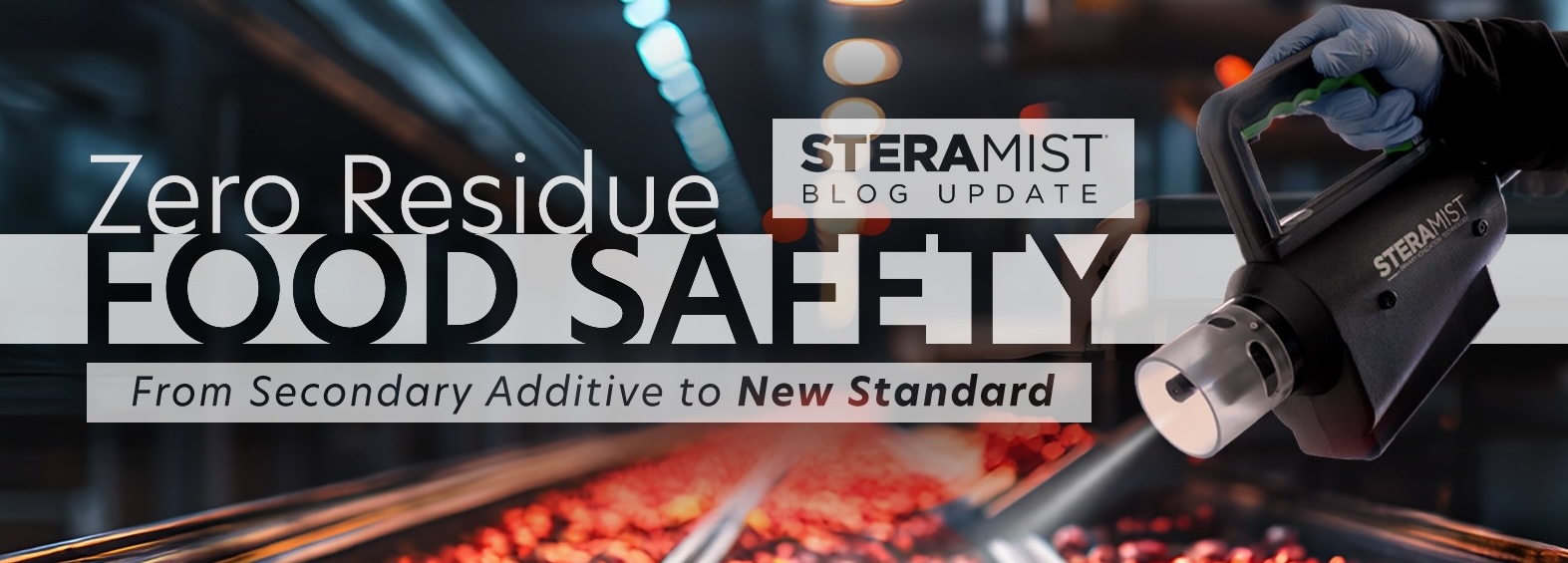
With a growing global movement that scrutinizes every step of the food supply chain, players at every stage of the food industry are feeling the pressure to deliver more than just product – they’re expected to deliver quality at a microscopic level. Automation in harvest and manufacturing methods continues to accelerate, and food safety is now shifting away from traditional chemicals and turning to innovation in disinfection to keep up.
The Massive Stakes of Invisible Threats
The urgency for better disinfection isn’t just about compliance, either. It’s about survival.
A single recall can exceed millions of dollars, demolishing customer trust, profit potential, and any brand unprepared to navigate the fallout. The financial impact of a food recall in 2026 is staggering, whether it is based on foodborne illness or another impact. Industry data shows the average direct cost of a single food recall now sits at $10 million, covering notification, product retrieval, and disposal. Indirect costs? Litigation, fines, and lost sales can easily exceed $100 million.
Additionally, reputational damage is crippling. Studies indicate 55% of consumers switch brands immediately following a recall, with 21% avoiding every product linked to the offending manufacturer indefinitely. When margins are already tight, a single contamination event, including foodborne illness, can result in irreversible market capitalization decline within just five trading days.
Whether addressing Salmonella, Listeria, or E. coli (and other pathogens that cause foodborne illnesses), it’s no longer enough just to sanitize. Innovation needs to bridge the gap between microbial reductions and product quality; complying with evolving safety standards while ensuring color, texture, and nutritional value remains intact.
SteraMist stands at the forefront of this rapidly shifting food safety landscape, backed by a portfolio of government research, third-party peer reviews, pilot studies, and real-world testimonies.
Unleashing Hydrogen Peroxide
While hydrogen peroxide is no stranger to food safety, the Food & Drug Administration (FDA) has only recently significantly expanded its approved use applications. On September 3, 2025, hydrogen peroxide was recognized as a safe and effective antimicrobial, oxidizing, and reducing agent across meat, poultry, seafood, fresh produce, dairy, bakery products, nuts, seeds, and more.
Hydrogen peroxide has long since been generally regarded as safe (GRAS) by the FDA, but the longtime framework of 21 CFR 184.1(b)(2) meant that expanded use outside of specific limitations required additional food additive petitions for general application, often leading processors to seek less-restricted methods out of convenience. However, the 2025 amendment (21 CFR 173.356) removed those guardrails with the exception of one rule: residues must be removed during processing.
“Zero Residue” Validation
Having remained fully compliant before the amendment, SteraMist streamlines even further with zero detectible residue.
Unlike traditional hydrogen peroxide vapor decontamination, SteraMist iHP decontamination utilizes cold plasma technology to create ionized hydrogen peroxide (iHP). This unique process generates submicron particles that rapidly decompose into only oxygen and humidity. This ensures a residue-free finish on food and contact surfaces, ensuring full regulatory compliance without the need for additional rinsing or wiping—steps that often risk re-contaminating the product.
TOMI Environmental Solutions has worked closely with the United States Department of Agriculture’s (USDA) Agricultural Research Service (ARS) to validate both the efficacy and residue of SteraMist onto food products – with clear and compelling results. Published in the Journal of Food Protection, a study focusing on post-iHP treatment residue when applied directly to apples, tomatoes, cantaloupe, and Romaine lettuce found that hydrogen peroxide levels decreased rapidly following application. A separate residue test onto Teflon, PP, and STS304 confirmed that no hydrogen peroxide residues were detected after treatment and proper ventilation.
Because the science behind iHP uses no stabilizers or added chemicals, SteraMist represents a significant advancement in food safety and food processing sanitation equipment. Cold plasma technology goes beyond simply avoiding residues, with USDA studies published in Food Microbiology revealing a 99.999% reduction of Listeria and Salmonella on produce due to enhanced cold plasma activation. Even when treated within commercial warehouses of large crates, the scalable science behind SteraMist delivered superior reductions, having brought pathogen and inoculated bacteria levels below detection limits. These standards are met while maintaining the produce integrity, appearance, texture, and vital nutritional content (Vitamin C, antioxidants, etc.).
SteraMist has not only been deployed into markets where integrity is critical, but into emerging verticals facing additional regulatory scrutiny.
On Paper & In Practice
In a partner study, iHP demonstrated the complete remediation of all microbial contaminants on a cannabis flower, including Powdery Mildew, Aspergillus, Salmonella, and E. coli – all without leaving residues, affecting plant potency, impacting visual characteristics, or diminishing organoleptic properties.
A leader in frozen desserts, Ziegenfelder Co., commented that the company achieved the lowest presumptive Listeria rates in its history after integrating SteraMist into protocols, noting that the technology left no residue or odor, “The Ziegenfelder Company with three U.S. locations in CO, CA, and WV has utilized SteraMist as part of their standard safety procedures on the manufacturing floor to mitigate Listeria Contamination. Since implementing SteraMist and other food safety measures, Ziegenfelder has realized the lowest presumptive Listeria rates in the history of the company,” stated the Director of Food Safety & Quality.
Charcuterie Artisans, using SteraMist to protect their production rooms, found that SteraMist allowed them to treat all Ready-to-Eat (RTE) surfaces within a 30-minute daily break. As a result, the need for nightly “wet” sanitation on sensitive electronics was eliminated, water damage to screens and motor boxes were reduced, and swab and pre-op ATP results to were brought to record-high levels of cleanliness.
Aiming to focus on efficiency without compromising results, Mayorga Coffee tried a wide array of sanitizers before finding that SteraMist sanitized surfaces without prolonged drying times or damaging stainless steel equipment, allowing them to quickly return to production.
In the poultry industry, collaborative studies at the University of Arkansas suggest that SteraMist provides an excellent method for the sanitation of poultry carcasses, having achieved significant, meaningful reductions in Salmonella contamination.
After an outbreak of Deformed Wing Virus (DWV) in honeybee hives, the USDA and National Institute of Food and Agriculture (NIFA) deployed SteraMist for a study, resulting in a vast reduction of infected honeybees with inactivation occurring in shorter times than more harmful methods (gamma irradiation, ethylene oxide, etc).
Centralized Disinfection, Unmatched
Designed with Food Safety Modernization Act (FSMA) protocols in mind, SteraMist features an incredible array of features designed to address every concern of food safety sanitization, including food processing sanitation equipment.
With versatility that allows for integration into every stage of the food process, SteraMist not only provides the baseline of microbial protection and recall prevention, but also preserves quality of product, avoids surface damage, and streamlines protocols to help brands maintain the quality they’re known for. Whether disinfecting RTE surfaces, directly treating produce, or decontaminating transport, or protecting food spaces of any size, SteraMist iHP delivers premium results for food safety in a suite of products enhanced by cold plasma technology.

Ensuring Food Safety at Scale
How a Leading Food Manufacturer Neutralized Spoilage Risks with SteraMist iHP TechnologyIn the high-stakes environment of food processing, early contamination detection is the only line of defense against outbreaks, financial losses, audits, and more. During routine sanitation checks, the food…
SteraMist TOMZ Presentation
window.df_option_8439 = {"source":"https:\/\/www.steramist.com\/wp-content\/uploads\/2025\/06\/2026-Final-TOMI-SteraMist-TOMZ-Presentation-1.pdf","outline":[],"overwritePDFOutline":false,"pageMode":"1","pageSize":"0","slug":"steramist-presentation","wpOptions":"true","id":8439}; if(window.DFLIP && window…
GMP Annex 1: Contamination Control Strategy
How the EU GMP Annex 1 Amendment Transformed Cleanroom Cleaning and Disinfection for Full Pharmaceutical Compliance.After initial announcements were made after months of speculation, it was clear the amendments to the EU GMP Annex 1 significantly reshaped the landscape of Annex 1 compliance. From…