
Cleaning vs. Disinfecting: What’s the Difference (And Why It Matters)
Key Takeaway
Cleaning removes dirt, dust, and some germs from a surface, but it doesn’t reliably kill pathogens. Disinfecting uses antimicrobial chemistry to kill the microorganisms that cleaning leaves behind. A surface can look spotless and still carry infectious pathogens, which is why both steps matter, and why the order matters too: clean first, then disinfect.
Why “Looks Clean” Isn’t Enough What Is the Difference Between Cleaning and Disinfecting?
Pathogens are invisible by design – it’s how they survive and thrive. A surface can look spotless and still carry microorganisms capable of spreading through a facility. That’s the problem with relying on cleaning alone: it might improve the visual appearance without fully addressing microbial risk.
Cleaning physically removes dirt, dust, organic residue, and some germs from a surface using soap, detergent, water, or wipes. It improves visual appearance and removes the soil that can shield pathogens from disinfectants, but it does not reliably kill the microorganisms that remain.
Disinfecting uses chemical agents (like hydrogen peroxide, bleach, or quaternary ammonium compounds) to kill or inactivate bacteria, viruses, and other pathogens on a surface. Disinfecting does not necessarily remove visible dirt; it targets what cleaning can’t see.
In short, cleaning prepares the surface, and disinfecting controls what you can’t see. Skipping either step leaves a gap, visible grime that interferes with disinfectant contact, or invisible pathogens that survive a clean-looking wipe-down.
SteraMist advanced disinfection technology ➔
Why “Looks Clean” Isn’t Enough
Pathogens are invisible by design; that’s how they survive and spread. A surface can look spotless and still carry microorganisms capable of moving through a facility. Relying on cleaning alone can improve appearance without addressing the underlying microbial risk, and that gap gets expensive:
- The CDC estimates healthcare-associated infections (HAIs) affect roughly 1 in 38 hospital patients on any given day, with about 518,000 HAIs recorded across U.S. acute care hospitals in 2015.
- CDC economic analysis has placed the direct annual medical cost of HAIs in U.S. hospitals between $28 billion and $45 billion, depending on methodology.
- The USDA Economic Research Service estimated the cost of foodborne illness in the United States at $74 billion in 2023.
These numbers reflect a simple pattern: shallow cleaning, without disinfection, gets expensive fast, whether in healthcare, food production, and beyond.
The Limits of Basic Cleaning
Basic cleaning, such as manual wiping, sprays, cloths, and detergents, is necessary and should always be part of a facility hygiene program. Removing visible soil and organic matter keeps it from interfering with disinfectant performance later.
But manual cleaning is only as consistent as the person doing it. Results depend on coverage, dwell time, product choice, surface condition, and technique. It’s easy to miss seams, hinges, undersides, handles, casters, cords, vents, corners, and equipment gaps; even a careful technician can only wipe what they can reach.
That doesn’t make cleaning unimportant. It makes cleaning the necessary first step, not the last one.
Going Beyond Deep Cleaning
Deep cleaning typically means stronger chemicals, more aggressive scrubbing, more frequent wipe-downs, or application devices like sprayers. It helps when a space has visible buildup or a known contamination concern.
But more chemicals don’t automatically mean better disinfection, and more scrubbing doesn’t automatically mean better coverage. Harsh products can cause odor, residue, corrosion, and safety concerns for staff, and because deep cleaning still relies heavily on manual labor, results can vary from room to room and shift to shift.
The better question isn’t “did we clean harder?” It’s “did we actually reach the places where contamination hides?”
Disinfection: Targeting Everything Left Behind
Disinfection is the step that addresses microbial risk after cleaning. It’s not about making a room look better; it’s about reducing pathogens on surfaces and in hard-to-reach areas: undersides of edges, behind equipment, around access panels, inside seams, along cords, near vents, and across complex surfaces that hands and wipes can’t easily reach.
Frequently Asked Questions
Does cleaning kill germs?
Cleaning removes some germs along with dirt and residue, but it isn’t designed to reliably kill pathogens. A surface that looks clean can still carry infectious bacteria or viruses.
Do you need to disinfect after cleaning?
Yes, for any surface where pathogen control matters, such as healthcare, food production, laboratories, schools, transportation, and similar settings. Cleaning removes the soil that can block disinfectant contact; disinfecting then addresses the microorganisms that remain.
What’s the difference between disinfecting and sanitizing?
Sanitizing reduces the number of germs on a surface to a level considered safe by public health standards, but it doesn’t eliminate pathogens the way disinfecting does. Disinfecting is a higher standard, governed by EPA-registered label claims for specific organisms.
What is ionized hydrogen peroxide (iHP)?
iHP, or ionized Hydrogen Peroxide, is SteraMist’s no-touch disinfection technology. It converts a low-concentration hydrogen peroxide solution into a fine, ionized mist that moves through a treatment area and contacts surfaces that are difficult to reach by hand or direct spray.
How long does dwell time matter for disinfectants?
Dwell time, how long a disinfectant stays wet on a surface, directly affects whether it achieves its labeled kill claims. Wiping a disinfectant away too soon, or letting manual application miss areas entirely, can undercut even a strong chemical’s effectiveness.
The SteraMist iHP Disinfection Difference
SteraMist uses iHP to deliver no-touch disinfection beyond the limits of manual cleaning. Instead of relying only on wiping or direct spray coverage, SteraMist converts a low-concentration hydrogen peroxide solution into a fine, ionized mist designed to move through the treatment area and contact surfaces that would otherwise be hard to reach — without the corrosion associated with harsher chemistries.
Key facts:
- SteraMist BIT Solution is a 7.8% hydrogen peroxide, EPA-registered disinfectant (EPA Reg. No. 90150-2), registered in all 50 U.S. states, Canada, and internationally.
- Whether applied as a surface spray or used to fog entire rooms, BIT Solution is designed for high-level efficacy, fast application, and broad material compatibility.
- It avoids many of the drawbacks of harsher chemistries, such as bleach, chlorine, abrasive residues, and heavy post-treatment cleanup.
- Independent validation uses test strips inoculated with Geobacillus stearothermophilus — the industry standard for validating high-level disinfection and one of the hardest organisms to kill — and consistently shows high-log reductions.
When used alongside thorough cleaning or deep-cleaning protocols, iHP decontamination adds a layer of protection in the places pathogens are most likely to survive: the spots a wipe or spray can’t reliably reach. Explore how this applies across healthcare, food safety, and life sciences environments.
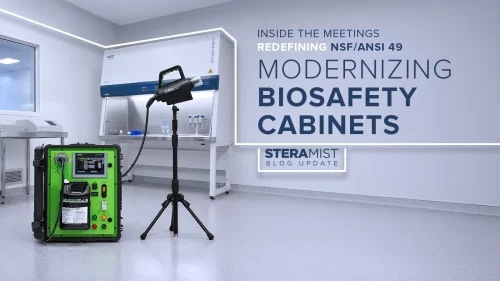
Modernizing Laboratory Biosafety: Why Decontamination Standards Are Getting a Major Upgrade
NSF/ANSI 49 | Biosafety Cabinet Decontamination StandardsIf you work in a laboratory, you know that biosafety cabinets (BSCs) are the unsung heroes of containment. They keep sample integrity intact and keep researchers safe from hazardous biological agents. But when it comes time to clean and decontaminate…
GMP Annex 1 Sterilization of Direct & Indirect Product Contact Parts
GMP Annex 1 and the Sterilization of Direct and Indirect Product Contact Parts: What Manufacturers Need to KnowEU GMP Annex 1, Section 5.5, requires that in aseptic processing, both direct product contact parts (like filling needles and pumps, which the product physically passes through) and…
Protecting the Front Lines: FIFA World Cup 2026
The world is coming. Is your facility ready for FIFA?FIFA World Cup 2026 brings 6.5 million+ visitors to North America. SteraMist’s ionized hydrogen peroxide technology ensures stadiums, hospitals, hotels, and restaurants are protected at the highest level before the first whistle blows.FIFA…