
Modernizing Laboratory Biosafety: Why Decontamination Standards Are Getting a Major Upgrade
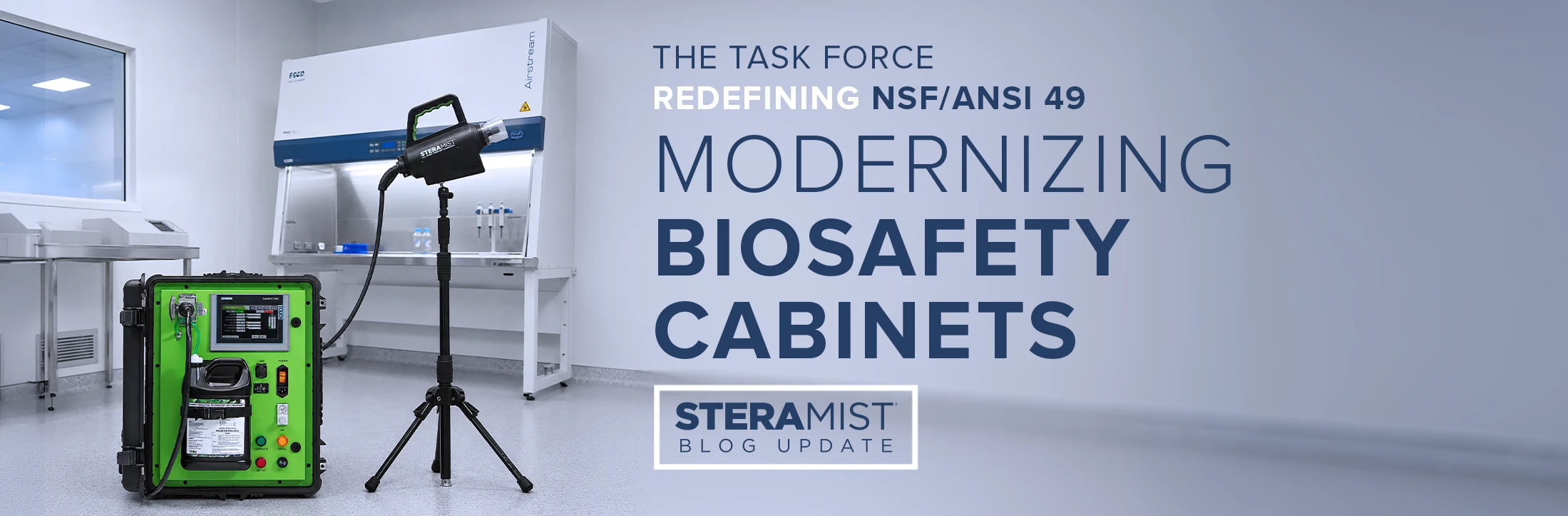
NSF/ANSI 49 | Biosafety Cabinet Decontamination Standards
If you work in a laboratory, you know that biosafety cabinets (BSCs) are the unsung heroes of containment. They keep sample integrity intact and keep researchers safe from hazardous biological agents. But when it comes time to clean and decontaminate those cabinets, how do we know if a new method is truly safe and effective?
Industry leaders on the NSF/ANSI 49 Joint Committee on Biosafety Cabinetry recently proposed a major evolution in how decontamination standards are structured. The committee voted to establish a dedicated task group to revise the decontamination annexes. This initiative shifts the focus from listing specific decontamination chemicals toward establishing performance-based criteria, material compatibility benchmarks, and standardized validation protocols.
What is Biosafety Cabinet Decontamination?
Definition: Biosafety cabinet decontamination is the process of neutralizing biological agents and pathogens within an enclosed primary containment device using gaseous, vaporized, or liquid chemical sterilants prior to maintenance, filter replacement, or equipment decommissioning.
Learn more about SteraMist Integration Systems for biosafety cabinet decontamination ➔
Why Biosafety Cabinet Standards Are Evolving
From Paraformaldehyde to Modern Technologies
When national standards like NSF/ANSI 49 were first established, paraformaldehyde gas represented the primary method for space decontamination. Over time, technological advancements introduced more efficient options, including ionized hydrogen peroxide (iHP) systems, vaporized hydrogen peroxide BSC protocols, and chlorine dioxide gas decontamination.
Updating static standards for every newly developed technology creates significant administrative delays. Moving toward universal criteria allows standards organizations to accommodate emerging decontamination systems without continuous document revisions.
Addressing Material Compatibility and Equipment Protection
Effective decontamination must eliminate pathogens without destroying the physical integrity of the containment unit. Historically, aggressive sterilizing chemicals like high-concentration sodium hypochlorite (bleach) have caused pitting, severe corrosion, and surface degradation on stainless steel interiors and internal blowers.
Establishing clear performance standards ensures that new chemical formulations undergo comprehensive evaluations for:
- Efficacy: Demonstrating verified spore log-reduction against biological indicators.
- Material Compatibility: Preventing structural degradation of HEPA filter seals, gaskets, and metal housing.
- Personnel Safety: Ensuring safe post-decontamination aeration and low residual vapor exposure.
Why not just let labs use whatever new chemical sounds best? Because the wrong chemical can ruin a $15,000 biosafety cabinet.
During the meeting, participants highlighted how harsh agents, like sodium hypochlorite (bleach), have historically pitted, corroded, and damaged stainless steel surfaces and seals inside cabinets. A decontamination method might kill bacteria effectively, but if it degrades the cabinet’s physical structure or HEPA filter seals, it creates a massive long-term safety hazard.
Key Takeaway: True decontamination isn’t just about killing microbes; it’s about killing microbes without destroying the cabinet or endangering the operator.
Key Benefits of Criteria-Based Decontamination Standards
| Feature | Legacy Prescriptive Annexes | Modern Performance-Based Criteria |
| Adaptability | Requires slow manual updates for every new chemical agent. | Instantly accommodates newly engineered decontamination technologies. |
| Validation | Relies on legacy methods created for specific legacy gases. | Mandates standardized third-party validation protocols. |
| Material Safety | Focuses mainly on pathogen elimination. | Balances biological efficacy with long-term material preservation. |
| Lab Flexibility | Limits facilities to listed chemical sterilants. | Enables facilities to adopt greener, faster, and safer innovations. |
The Role of Independent Third-Party Validation
A central proposal in the revision initiative is requiring third-party validation for novel decontamination methods. Independent laboratory testing ensures that commercial decontamination systems deliver consistent, repeatable kill rates while protecting cabinet construction materials.
Lab managers, biosafety officers (BSOs), and field certifiers benefit directly from these modernized guidelines. Clear, objective criteria streamline procurement decisions and reduce operational downtime during routine laboratory maintenance.
GMP Annex 1 Sterilization of Direct & Indirect Product Contact Parts
GMP Annex 1 and the Sterilization of Direct and Indirect Product Contact Parts: What Manufacturers Need to KnowEU GMP Annex 1, Section 5.5, requires that in aseptic processing, both direct product contact parts (like filling needles and pumps, which the product physically passes through) and…
Cleaning vs. Disinfecting: What’s the Difference (And Why It Matters)
Key TakeawayCleaning removes dirt, dust, and some germs from a surface, but it doesn’t reliably kill pathogens. Disinfecting uses antimicrobial chemistry to kill the microorganisms that cleaning leaves behind. A surface can look spotless and still carry infectious pathogens, which is why both steps…

Protecting the Front Lines: FIFA World Cup 2026
The world is coming. Is your facility ready for FIFA?FIFA World Cup 2026 brings 6.5 million+ visitors to North America. SteraMist’s ionized hydrogen peroxide technology ensures stadiums, hospitals, hotels, and restaurants are protected at the highest level before the first whistle blows.FIFA…