
Case Study: Testing SteraMist iHP Against Listeria Biofilm
An independent laboratory study puts ionized Hydrogen Peroxide (iHP) up against one of food processing’s most persistent contamination problems.
At a glance: Listeria Study
- Challenge: Listeria biofilm that survives routine sanitation
- Testing: Independent laboratory, September 2026, three replicates
- Result: Listeria at or below the lab’s detection limit in eight of nine treated samples
- Expert guidance: Josh Hasty, Ph.D., formerly of Tyson Foods and Cargill
The challenge: Listeria that keeps coming back
Listeria monocytogenes is a foodborne pathogen and a recurring cause of costly product recalls. What makes it so difficult to control is biofilm, a protective layer that bacteria build on surfaces. Inside biofilm, Listeria can adhere to equipment, drains and conveyors and withstand routine sanitation.
For food safety teams, that means a facility can pass one swab and fail the next. The organism is not reintroduced; it never fully left.
The approach: 3-4 second spray application time
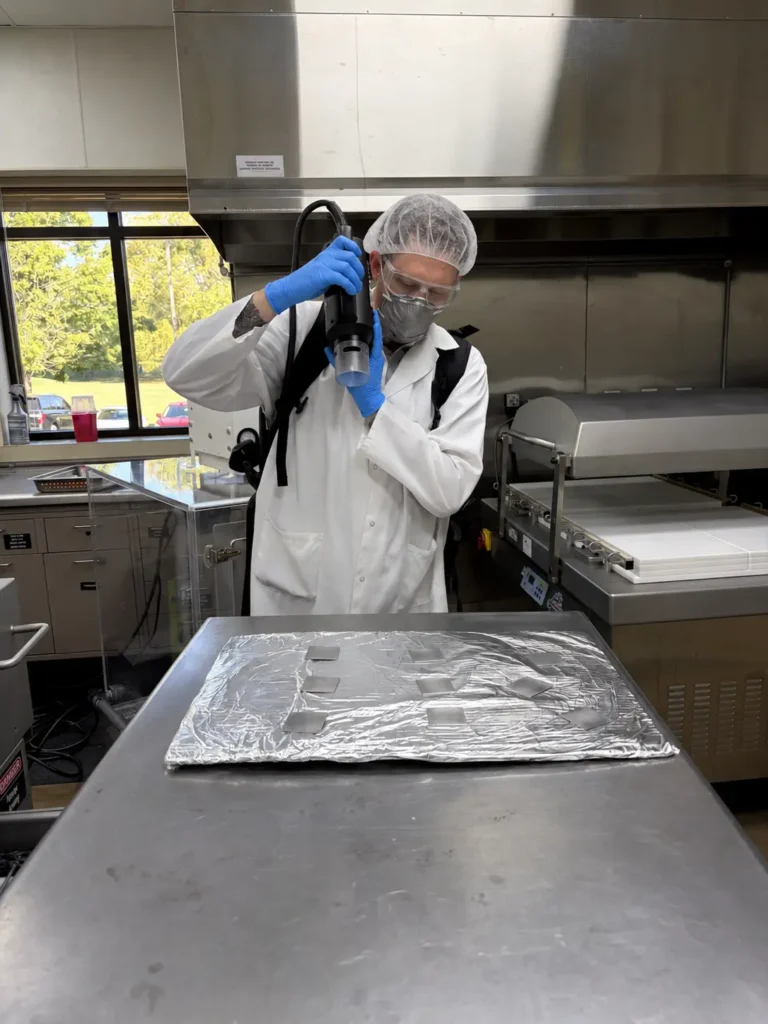
To see how SteraMist iHP performs against this problem, TOMI commissioned an independent laboratory study. The lab grew mature, heavily loaded biofilms on stainless steel test surfaces, then treated them with a SteraPak and a 3-4 second spray application time. Treated samples were compared with untreated controls across three separate replicates.
The study tested two organisms:
- Listeria, the pathogen of greatest concern in ready-to-eat and protein processing
- Lactic acid bacteria, common spoilage organisms that shorten shelf life
The lab also tested Listeria on threaded screw and manifold parts, chosen to represent the kind of hard-to-reach harborage point where contamination hides in a real plant.
The results: 7+ Log Reduction on Listeria
| Test: 3-4 second spray | Untreated samples | After SteraMist iHP (individual sample comparisons) |
| Listeria biofilm, flat surfaces | Tens of millions of bacteria | Reductions of more than 7 log |
| Lactic acid bacteria biofilm, flat surfaces | About 500,000 bacteria | Reductions of more than 5 log |
| Listeria, screw and manifold parts | About 2.6 million bacteria | Reductions of more than 3 log |
Untreated values are averages in colony-forming units per mL. Reductions compare individual untreated and treated samples.
On flat surfaces, individual sample comparisons showed Listeria reductions of more than 7 log. On threaded hardware, where the mist has the furthest to reach, reductions were lower, at more than 3 log. TOMI is now using that data to develop treatment cycles for complex equipment.
Read the full press release: TOMI Reports Independent Lab Results for SteraMist iHP Against Listeria Biofilm ➔
Why a dry process matters in food plants
SteraMist iHP converts a low concentration of hydrogen peroxide into a fine, dry mist that reaches surfaces throughout a space. It leaves no residue and requires no wiping or rinsing. In a food plant, that means a decontamination step that fits within the sanitation window instead of extending it.
The expert perspective
TOMI is working on its food safety program with Josh Hasty, Ph.D., CEO of FH Services, LLC. Dr. Hasty has led food safety, quality assurance, and R&D for some of the largest protein companies in the world, including Tyson Foods and Cargill.
“Listeria is the problem that keeps food safety teams up at night, and biofilm is what makes it so hard to get rid of,” said Dr. Hasty. “These tests used a heavy, well-established biofilm, and on flat surfaces nearly every treated sample came back at or below the detection limit. A disinfection process that leaves no residue and needs no wiping or rinsing fits the way food plants actually operate. SteraMist gives food processors a new way to go after one of their most persistent contamination problems.”
Frequently asked questions
Is SteraMist iHP effective against Listeria biofilm?
In independent laboratory testing, SteraMist iHP reduced mature Listeria biofilm to the lab’s detection limit or below in eight of nine treated samples.
Does SteraMist iHP leave residue?
No. SteraMist iHP is a dry mist that leaves no residue and requires no wiping or rinsing.
How does it perform on hard-to-reach equipment?
On threaded screw and manifold parts, individual sample comparisons showed Listeria reductions of more than 3 log. TOMI is developing treatment cycles for complex equipment.
Results are from laboratory testing and may not reflect performance under field conditions.